Woke up early this morning to go to work. After rolling over to turn off my alarm, it hit me that the fun-filled weekend was over and it was back to the real world. . . the real world where we were going to be setting big trusses all day out in the wind, after which I would come home to homework and a 9:00 deadline for which I needed my textbook which hadn't arrived yet.
Needless to say, neither of those things made me feel ready to start my day. I kind of wished I could go back to sleep for awhile. But I couldn't. I'd already told Larry I could help him on his big truss-setting day.
Rolling over one more time, I asked God to give safety while we were working up high and to help my textbook come in the mail. Why? Because if there's two things I wanted for that day, it was safety and my textbook . . . and if there's two things I don't control it's accidents and the U.S. postal service! =)
Later during devotions I was reading in Mark where Jesus reminds the disciples that if they pray believing, they will receive, even if it involves things like commanding a fig tree to die or moving mountains. I knew these requests weren't anywhere as dramatic or unusual as those, but did believe God had heard and as I went through the rest of the day I kept wondering how he was going to answer.
Long story short, the concrete walls we were working on were pretty high (it's for a gym after all) and it was pretty windy at first, but setting the trusses went faster than we thought and without any accidents. The wind slowed down for the second part of the day and we were able to get all the trusses up by just before dark – something we hoped we could do but really didn't think would work out.
During our short lunch break, I called home to find out if I needed to go pick up another textbook from Millersville so I could keep up with my classes in case my ordered book didn't come for another week (which it very easily could have) and found out that it had arrived, and only because the sender was nice enough to ship it expedited and very quickly after I ordered it – and all that without him even knowing that I needed it quickly because I had forgot to tell him when I bought it.
Anyway, I was encouraged to see how God answered two simple prayers. They weren't really out of the ordinary and could easily be explained by perfectly natural causes, but God used them to remind me that he does listen and act when we pray.
There was no reason we shouldn't have had a safe day at work since we were being careful on a tough job, but there are many people who didn't have a safe day at work today. There was no reason why my textbook shouldn't have come in the mail seeing as it was shipped on time, but not all sellers are nice enough to ship before they absolutely have to. I am thankful for both.
Tuesday, December 21, 2010

Tuesday, December 7, 2010
Field Journal
I recently completed four weeks of field experience. It's part of the teacher program and state law that prospective teachers spend at least 35 hours observing and participating (interacting, teaching, etc.) in a real life classroom before student teaching. The following is from one of my many field journals I completed and handed in to my professors at the end. . .
The culture at this High School appears very professional. They are considered a high achieving school and want to maintain that image. Because their reputation is good, their code of conduct is set pretty high, creating that professional atmosphere. The teachers do cooperate and the first day in the school I saw teachers cooperating to time their lessons to each other and create a common final assessment. At the same time, I could see that their reputation also puts some pressure on teachers to have their students perform well, creating some competition among teachers. It wasn't much, but there are politics that go on among the faculty and there was some whispering that went on between cooperating teachers.
Teachers here are expected to help a the tutoring center, do cafeteria duty, help with bus duty, and oversee study hall and home rooms. Teachers often have duty together and the conversations during these seems to be somewhat informal and pretty friendly. The faculty room doesn't get used much by teachers and most of them just eat in their classrooms by themselves. The one conversation I heard in the faculty room (I don't think it was even between two teachers) was about a celebrity scandal. Aside from being somewhat crude, it had nothing to do with school and I got the feeling that not much of anything happens in the faculty room.
I asked about support for first year teachers and was told that there is a program for them, but I gathered that it isn't always comprehensive or terribly relevant to the actual needs of new teachers. It meets about once a week at first and then gradually weans new teachers off. They meet and discuss theories of teaching and some procedures, but I was told the the best support comes from finding another teacher who will take you under their wing for a little and tell you about how the school works.
The classroom I was in is mostly project based so the structure was pretty loose. Kids had a lot of in-class work time and were given a lot of freedom about how and they wanted to complete their projects. A lot of the classes were AP classes and this structure seemed to work fairly well for them and some kids made the most of the freedom to go above and beyond. However, for students who weren't highly motivated, it gave them time to procrastinate and socialize. In these cases, the teacher would usually come over to the table to try to get them back on track. Intervention was informal and usually consisted of a quiet comment or simply waiting till the class was quiet enough to continue with the instructions.
The less formal environment led to a lot of interaction between students and the teacher, and I think most students found her to be down to earth. They were pretty comfortable talking with her and viewed her as someone who was enough like them to understand them. Some of the students really liked and respected her for the freedom she gave them, and some didn't. In each class, there were a few students who didn't like her because they wanted more direct instruction than she gave them and felt that she wasn't teaching them enough.
Special education wasn't a big part of the classroom. Four of the six classes were AP classes and there were some gifted students in them. The teacher told me that the biggest difficulty with gifted students was getting them to take risks instead of just worrying about the grade. Since the assessment was project based, the teacher told me she set it up specifically so gifted students could make their projects as complex and thorough as they wanted to.
There were a couple kids in class with IEP's and they had a special ed teacher who would come in during those classes. She would walk around the classroom, checking in on the tables where they were to make sure they were on task. Again, the project-based assessments were naturally scaffolded to allow students to achieve at the level they were comfortable. Other than that, I didn't see a whole lot of accommodations that were made to the classroom. Students with special needs were simply allowed to do projects that were simpler than other students.
The student I shadowed was definitely a case of a smart student who is underachieving. He excels in the classes he likes, but he is doing poorly in all the others. As I watched him, it became apparent to me that one of the biggest reasons for this is his social life. It's not that he was not against or disinterested in learning, but he was more concerned more interested in being cool. He would participate when “forced” to (and I was surprised at how good his answer was when he was specifically asked) but he wouldn't give the answer of his own accord because it is cooler to not participate. If I was going to teach him, I think I would sometimes “force” him to share with the rest of the class – as long as I had checked up on him and knew he had a good answer. It is a way to let him be involved without hurting his social status. Also, I think I would let him work in groups as a reward, but let him know that if he gets off track he will be switched to another group or have to work by himself for a little.
His favorite class was construction and he was anxious for me to see him in this class. As I watched him and the other boys in shop class, it became apparent to me that they all liked working with their hands better than with a pencil and paper. The same went for physics class, although there he was working with a group again and spent part of the time goofing off because it made the others laugh. However, overall he was naturally more excited and eager to learn when there was a hands-on project to do. I think if he was in my class, I would give the option of making something (maybe a monument for a particular event) for one of the assessments. I would also try to bring in tangible artifacts for him and the rest of the class to put their hands on and get them interested.
Unstructured time was not a good thing for this student. There were two classes where the students were expected to work on their own and weren't given specific instructions or in-class-deadlines. This was when he would zone out. It wasn't that he couldn't follow instructions because I observed him following perfectly when there was a teacher stepping the students through a process in Econ, but when the in clas work time was totally self-guided, he didn't seem to know where to start so he just didn't. I think if I was going to used a project based assessment for him and allow in-class work time, I would need to structure the class so they do the project in small steps and need to report to the rest of the class at least once or twice during the day. Being told where to start and just knowing that the teacher is going to call on several random groups to show what they have accomplished that day would do wonders for providing motivation. It would also help students who are falling behind because they can listen to what their classmates have done and imitate it if they are at a loss for ideas or direction.
Wednesday, October 27, 2010
Through different eyes
Kids see things through different eyes.
I was sitting in choir, listening to Mr. Hanson read the story of the prodigal son. Listening to him read, I was picturing the story unfolding in my mind as I listened to him read . . .
“And the father, seeing his son from afar off, ran to meet him and fell on his neck and kissed him--”
and suddenly from the audience there's a quiet “ew gross!”
I'd almost forgotten that the kids from children's church were in with us this Sunday! Didn't take me long to remember. lol. I tried not to laugh, but I'm pretty sure someone watching me would have known I wasn't thinking about the prodigal son anymore. That's what I love about kids . . . they remind me what a simpler view of life looks like, and how funny it can be at times!
Fortunately, the message on the parable was actually very good and I was able to take something from the sermon besides that one kid thought the reunion between father and the prodigal son was a little too sentimental and bordering on sloppy.
Pastor pointed out that many times we are so focused on the prodigal son that we forget that there was a second son who was just as alienated from the Father – and he was the one who was living in the same house with him! He really didn't love his father any more than his brother who ran away, but he conformed outwardly because there was something to be gained by it. However, when his brother came back, all the anger, dissatisfaction, and envy came out.
For most of us in church, it's pretty comfortable to hear about the younger son. After all, since we're in church, it's a pretty good sign this parable isn't aimed at us. Or is it? Jesus gave this parable primarily in response to the Pharisees, and it was no accident he included the older brother at the end. In the end, it was the younger brother, not the older brother who kept all the rules all his life, who had a better relationship with his Father and got more joy out of it. Why? Because the younger brother realized that he couldn't, and didn't need to, earn his father's love.
The Father came out to greet both his sons. He initiated, and re initiated the relationship and love to both of them, not the other way around. One of them accepted it and was grateful for it because he knew he didn't deserve it. The other couldn't accept it because he was more concerned with being good than being close to his Father.
The lesson I learned: The goal of life is not to be good. (It's not to be bad either, in case you were wondering!) The goal of life is to love God. If your being good is the result of you simply not wanting to be bad, you're missing the point. If your fellowship with God is not your true motivation for dressing the way you dress, saying the things you say, or doing the things you do, I don't care how good you look, you may very well be the older brother in this parable.
Not necessarily a fun message to hear, but one that I think is very necessary. . . especially for those of us who have been in church all our life.
Thursday, October 14, 2010
Congrats, Buddy!

Josh got his first archery deer last Saturday. So here you go, little brother . . . your twelve minutes of fame on my blog. Hope there's many more for you =)
Upon request,(we won't say by whose) the poll of whose deer is bigger is being left up the replies of viewers like you =)
Tuesday, October 5, 2010
First day of Archery . . .
. . . was more successful than it usually is for me!

Contrary to what the picture looks like, it's really not Rudolph the red-nosed reindeer -- it's just his green-nosed cousin! j/k
It wasn't huge, but it was a fairly nice sized doe. It was beautiful weather to be in the woods the first day, and on top of thatI was thankful God let us put some meat in the freezer early this year.
Monday, September 27, 2010
Our (short) vacation to the shore

Sunrise at the beach. Somehow it always looks better at the ocean. Greg Josh and I went for a walk Monday morning. It was definitely worth it.

Doing one of our favorite things to do on vacation . . . eating! Okay, so we do more than that, but that's probably what my mom would say when she's packing the food. However, just to show that we do more than eat, I'd better include a few more pictures.

I think someone added too much Bubble Bath to this pool! What can I say . . . some days you just get washed up. I can't remember if I rode this wave or if it rode me! The waves were pretty aggressive that day, so we did quite a bit of both. It seriously feels like you're in a blender when you get caught under one. I should know, that's how I dislocated my shoulder 5 years ago. This vacation was definitely better than that one!

After riding waves (and after Greg got pretty badly brushburned by one), we decided to have a sculpting contest. We had one the day before which featured cars, but I don't want to talk about that. Thankfully there was not a camera there that day. Let's just say cars were not my strong point! This time we decided to try boats, which were much more to my liking. We were smarter this time and built them next to an inland pool instead of on the oceans edge. We lost a couple cars like that the day before to rogue waves, much to the amusement of people who were walking past and stopping to see what we were doing. I guess they aren't used to seeing three full-grown guys making sand sculptures. (Well okay, to full grown guys and one little boy . . . a little boy who will kill me if he ever reads this!) These are the three boats we came up with. You'll never guess which one is mine! =)

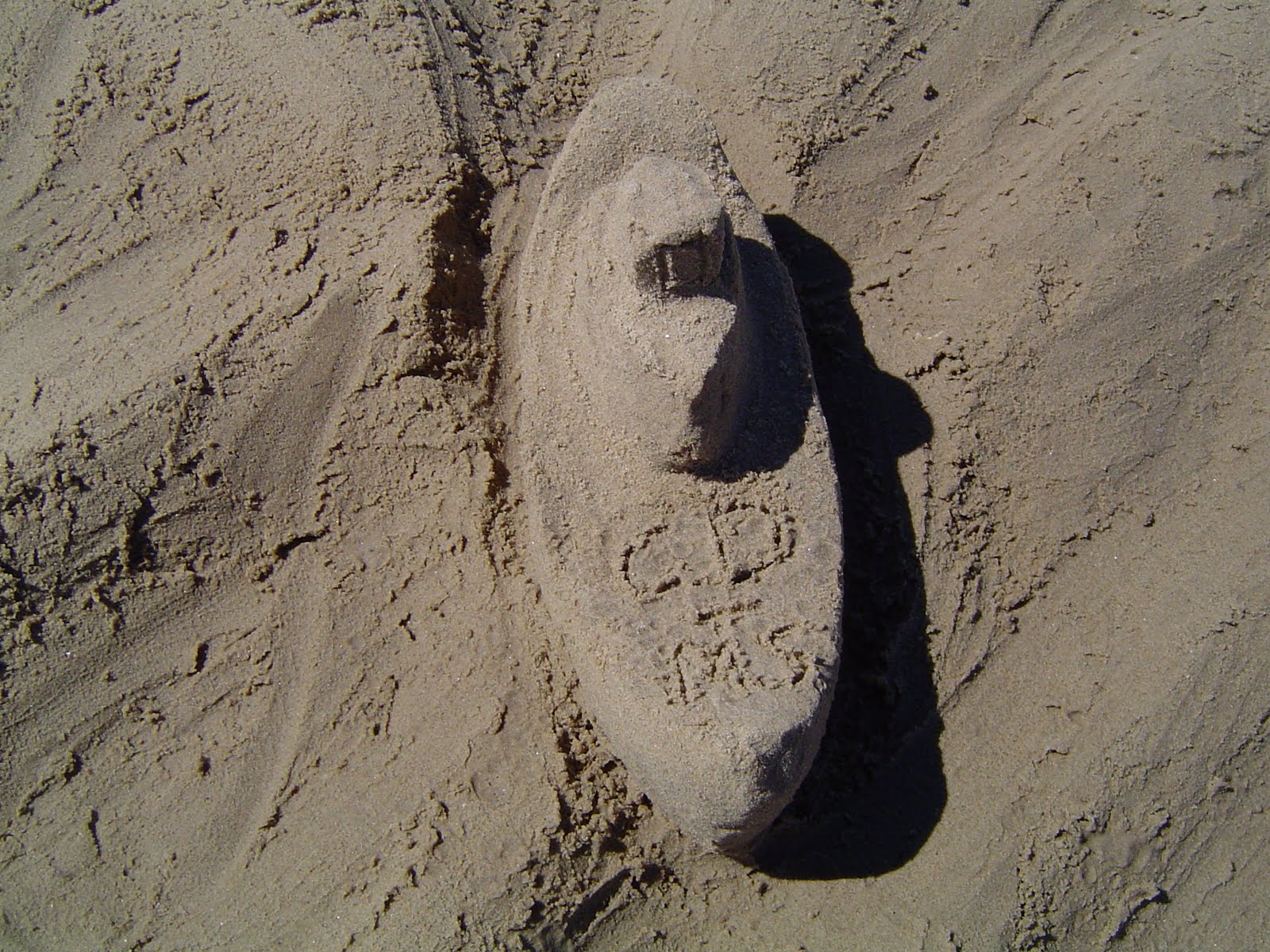


As you can see from the back of this boat, we all had some breakdowns. Some more than others. I think Josh held the record with about five restarts! We all thought it was hilarious when someone else's sand collapsed -- only to hear them laugh twice as hard as ours did the same a few seconds later!

Greg, hard at work. This was his second attempt. His first attempt was significantly bigger, but it kept sinking on him. He made up for the small size by accessorizing with masts and sails.

After sand sculpting, we went back for one more dip in the ocean. We actually weren't planning to get very wet, but Josh had other plans . . .

After running right up behind us and splashing us, he repented and apologized. Well okay, we helped him with the repentance part a little bit =)

Did I ever mention my brothers step all over me? Nothing I like more than Greg's wet, sandy foot climbing all over me! lol Actually, if you saw what happened right after this, you would say Josh and I had the better part of this process. Greg lost his balance backwards and did a rather amazing head plant in the sand. Fortunately he didn't land completely on his head and it didn't really hurt him.
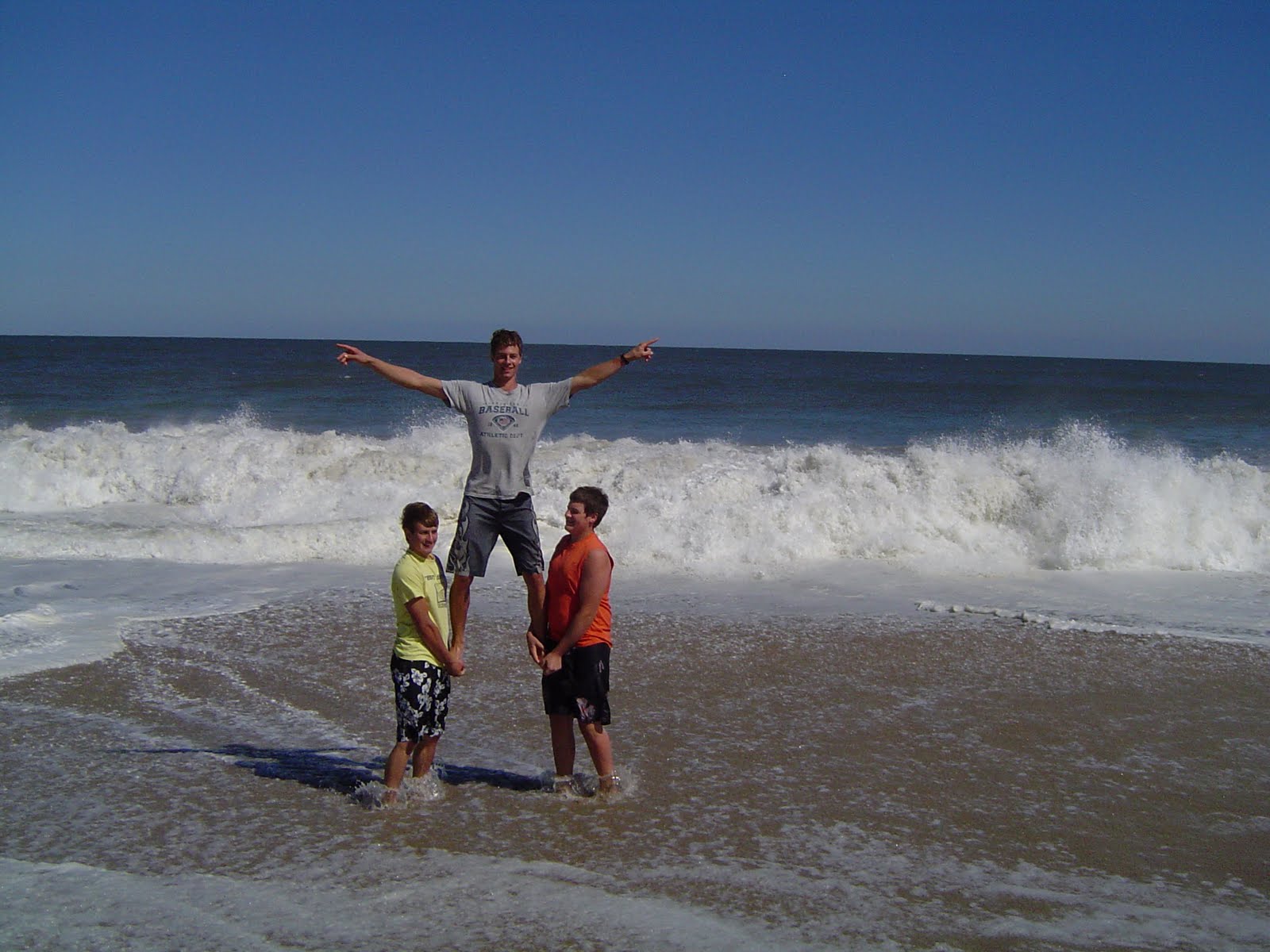
I managed to get up without doing a head plant. I was feeling pretty proud of myself, but this didn't last long. As you can see, Greg had to go and top me . . .

Actually, Greg was the only one who could do this because Josh and I are the only two close enough in height to make a stable platform. I have to admit, it's a cool picture though.

Mom and dad didn't want to do the pyramid picture for some reason . . . so they got one of the few "normal" pictures of the weekend =)

Last picture of the Stauffer guys at the beach. Unfortunately, Heather and Lindsey couldn't clear their schedules to make it down for this trip. It would have been more fun if they had, but they were keeping pretty busy at home and had some exciting times of their own! =) Thankfully, no one got hurt.
Overall, it was a very nice vacation. It was very last minute and involved very little planning, but sometimes those vacations are the most fun. Thankfully, everything worked out, despite a van that started leaking transmission fluid halfway down. God answered prayers and with a cautious driving strategy that involved multiple checkups and not going over 55 mph on the way home, everything worked out and we made it back home safely.
Wednesday, September 22, 2010
From devotions this morning
I was reading in Duet. 6-9 last night and this morning. In this passage God is talking to the Israelites through Moses before they head into the promise land. In it, He TELLS them that they will forget him as soon as things start going well. We know from history that this is exactly what happened.
How could they? He warned them, right?
In Duet. God told the Israelites what they needed to do. He tells them that when they reach the promised land, they need to consciously take time to remember where they came from (Egypt), and who got them to the promised land (Himself). He told them to review the commands and meditate on their need of him every day. If not, He said they would soon think they had earned the blessings and forget how much they need God. He told them, but as always, knowing is easier than doing.
I was talking to another Christian named Blake after Bible study last night, and we both agreed that mediocrity is the biggest struggle for us. I hate how easy it is for me to be complacent with my own life and not reach out to others, especially at school. It is useless to try to reachout to others if I don't have a passion for God, but a passion for God is something that is nearly impossible for me to maintain on my own. I can do my part by reading and praying, but there is no way I can create a passion for God. Convicting and frustrating at the same time.
If I don't find a way to remember how much I need God, I know beyond a shadow of a doubt that I will mediocre life. Not too bad, not too good, just lukewarm, and that is exactly what God says he hates. Unfortunately this is the hardest time for me to remember that because life is going smoothly. I need that urgency/thirst I have for God when times are bad, but I don't know how to keep this mindset when times are good.
Frustrating and kind of scary to realize that your biggest battle right now is against something so slow but so natural. Complacency is so powerful that I don't think anyone is really up to the challenge on their own, but that is naturally how we approach it – on our own. Without the grace of God to show the urgency of the need, the result is slow, predictable. As slow and predictable as it is, it will kill you if you don't take an active role against it.
How many mature Christians do you know who know so much that they haven't been really convicted in a long time? How many mature Christians do you know who love God fervently on their own, but haven't had the courage to share this passion outside a “safe” setting (i.e. church or Christian circle) in years? I know of a lot more than I would like to. Reading through Duet., it scared me to realize how easy it is to become one of them.
Experiencing God's blessing is not a safe place to be . . . unless you can remember how much you need Him. That takes conscious effort and a lot of work. More than that, it requires the grace of God. Have you asked for it recently, or have you forgotten that you need it?
Some people seem to naturally realize how much they need God's grace and how unworthy they are. Consequently, they struggle with doubts about whether God's grace really can extend to them. I'm not one of them. I don't struggle with realizing God's grace can cover me -- I can accept that -- I struggle to remember how much I need it. Reading Duet. and talking to Blake made me realize that I may need it most right now. Not so much to save me from drastic sin, but to keep me from being lukewarm.
Subscribe to:
Posts (Atom)

